
Which Halo UV Adhesive Is Right for You? Fuse, Bolt, Hue, Hush, and Bond Compared

If you're looking at Halo Fuse, Bolt, Hush, Bond, and Hue wondering which UV adhesive you should choose, start here.
All five are designed for UV lashing. All five cure within the 395–405 nm range and work with Halo UV lights. But they aren't interchangeable—and the best adhesive for you depends less on which one is “best” and more on what you want from your formula.
The easiest way to choose is to look at four things:
How quickly do you want the adhesive to cure under the light? What viscosity do you prefer? Do you want a clear or tinted adhesive? And is reducing cyanoacrylate and fumes a priority?
Here's how they compare.
The Halo Adhesive Lineup at a Glance
Halo Fuse
0.3-second cure | 80% cyanoacrylate | Medium viscosity | Clear
Our fastest-curing UV adhesive and one of our lower-cyano options. Fuse is a great fit if you want extremely short light activation, medium viscosity, and reduced cyanoacrylate without giving up speed.
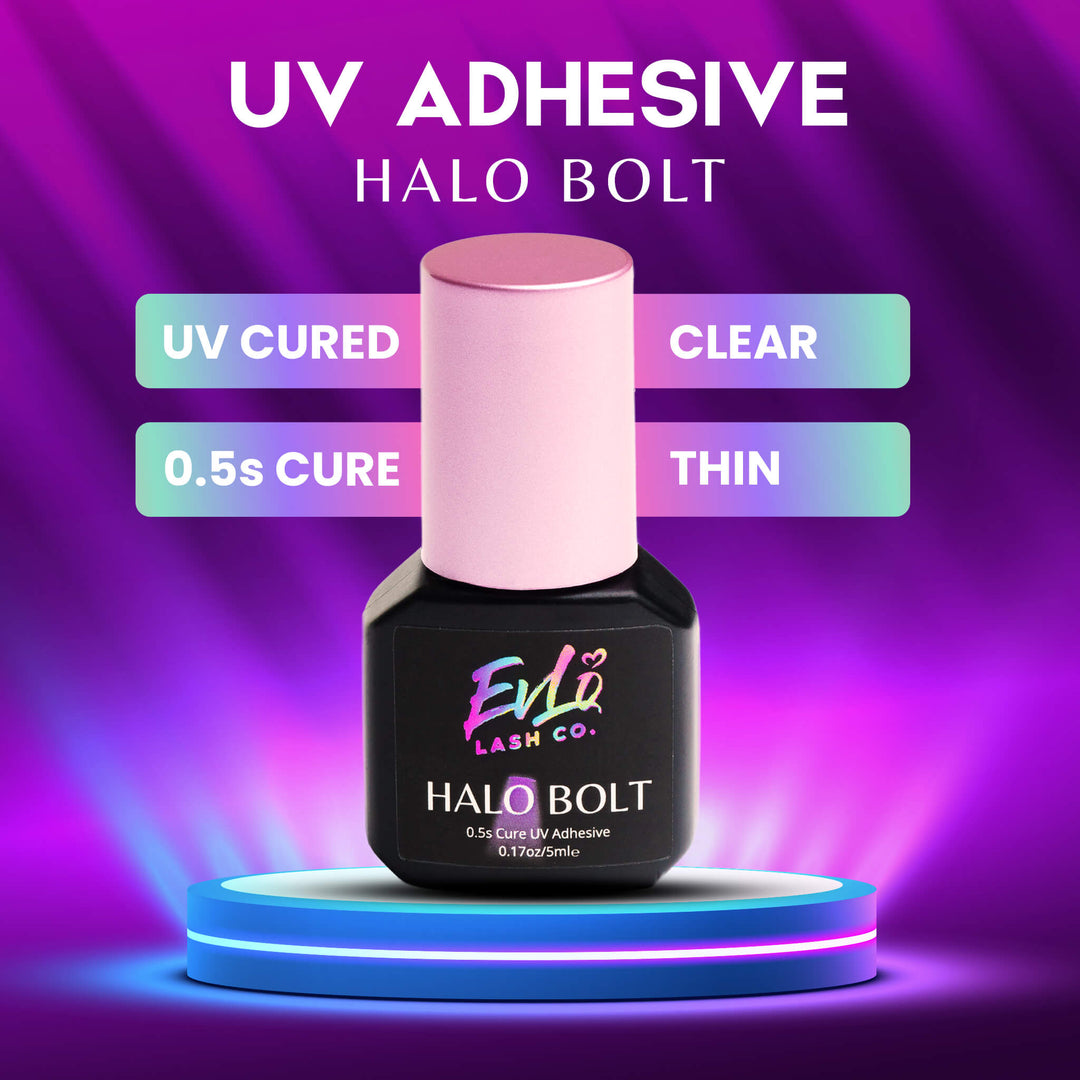
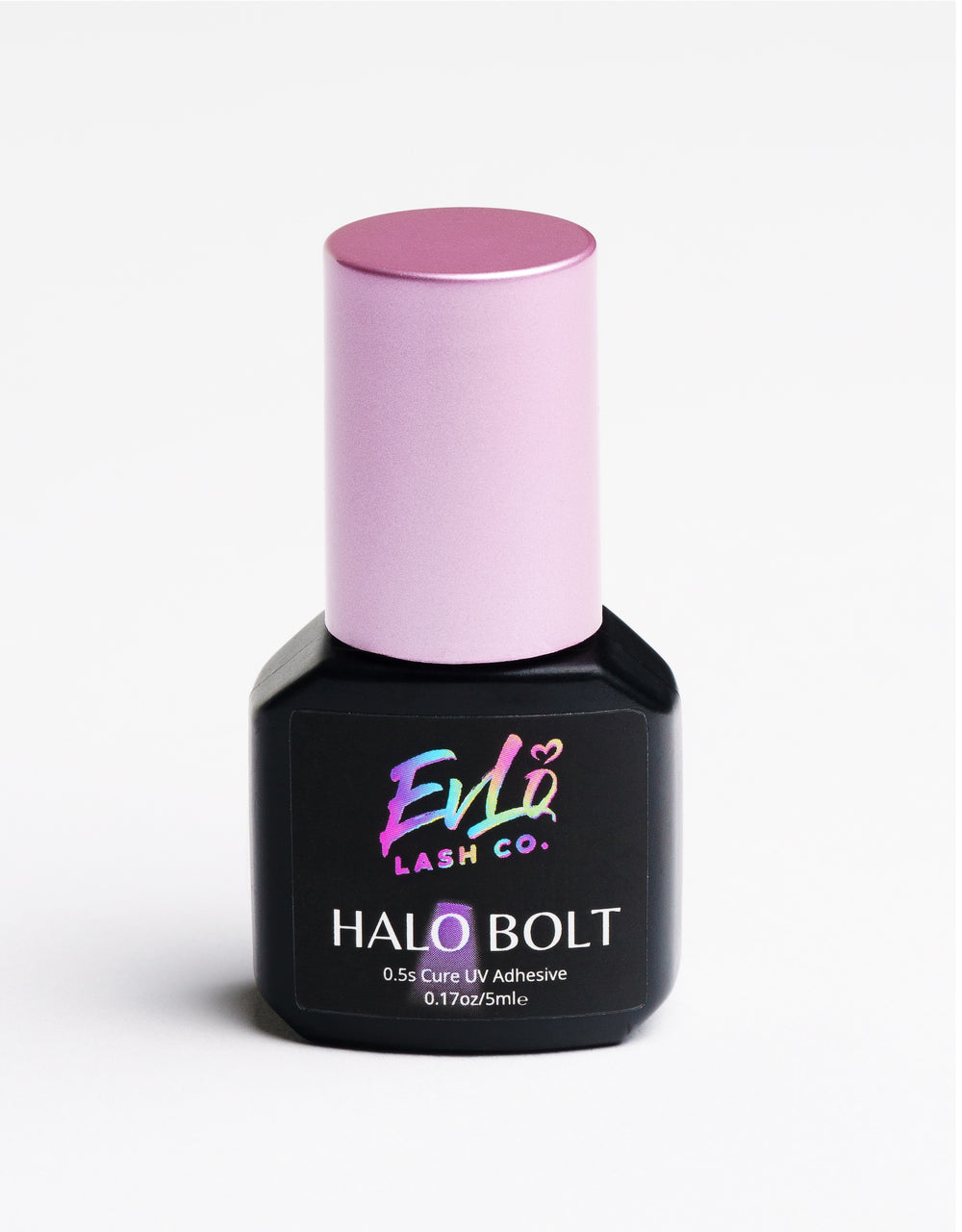
Halo Bolt
0.5-second cure | Thin viscosity | Clear
A longtime favorite for artists who prefer a thinner adhesive and a very fast cure. Bolt gives you a quick curing rhythm while maintaining the feel of a thinner lash adhesive.
Halo Hue
1-second cure | Medium-thin viscosity | Light purple
Hue sits right in the middle on cure speed. Its subtle purple tint makes the adhesive easier to see on the extension, which can be especially helpful when you're trying to control your dip and adhesive amount. It's a great choice for artists who want visibility without switching to a black adhesive.
Halo Hush
2-second cure | 75% cyanoacrylate | Medium viscosity | Clear
Our lowest-cyano formula, designed for artists who want to reduce adhesive fumes while still getting the control and retention of UV curing. Hush is also a great choice if you prefer a medium-viscosity adhesive and a more deliberate 2-second cure.
Halo Bond
2-second cure | Thin viscosity | Clear | Beginner friendly
Bond was our original UV adhesive and remains our go-to recommendation for artists who want a thin consistency and a slower curing rhythm while learning UV lashing.
So instead of thinking of the lineup as “beginner versus advanced,” think of it this way:
- Fuse = fastest cure + medium viscosity + lower cyano
- Bolt = very fast cure + thin viscosity
- Hue = 1-second cure + visible purple tint + medium-thin viscosity
- Hush = lowest cyano + medium viscosity + 2-second cure
- Bond = thin viscosity + 2-second cure + beginner friendly
First: What Does “0.3-Second Cure” Actually Mean?
This is worth clearing up because cure speed with UV adhesive works differently than dry time with traditional lash adhesive.
When we say Fuse has a 0.3-second cure, that does not mean you have 0.3 seconds to dip, place, and perfect your extension.
The adhesive remains uncured until it receives the appropriate light.
You can isolate, dip, place your extension, make sure your attachment is where you want it, and then activate your light.
The cure time tells you approximately how much light exposure the adhesive requires once you activate the lamp.
That means your personal lashing speed doesn't necessarily determine which adhesive you can use.
What changes is your curing rhythm.
With Fuse, you tap the light and move on almost immediately.
With Bolt, you're looking at about half a second.
With Hush or Bond, you hold the cure for approximately two seconds.
Across hundreds of lashes, those differences can add up. We break down the time savings in our post on how LED lashing can reduce chair time.
Do You Want the Fastest Possible Cure?
If reducing cure time is your priority, Fuse is the obvious choice.
At 0.3 seconds, it is our fastest-curing Halo adhesive.
That doesn't mean you need to rush your placement. Place the extension correctly first, then activate your light.
Where Fuse feels fast is what happens after you hit the pedal. The bond cures almost immediately, allowing you to release, move to the next lash, and keep going.
If you like that fast rhythm but prefer a thinner adhesive, Bolt's 0.5-second cure may be a better fit.
The difference between 0.3 and 0.5 seconds sounds tiny on paper, but repeated hundreds of times during a full set, it can make a noticeable difference.
We compare the two more closely in our Halo Bolt vs. Halo Fuse guide.
Do You Prefer Thin or Medium Adhesive?
This may actually matter more to your everyday experience than cure speed.
Some artists love an extremely thin adhesive because they can make a quick, clean dip without carrying too much product.
Others prefer a little more body because they can see and control the adhesive more easily.
If you prefer medium viscosity, look at:
- Fuse
- Hush
If you prefer a thinner consistency, look at:
- Bolt
- Bond
If you're switching formulas and something suddenly feels different, don't automatically assume the adhesive isn't working. A change in viscosity can change your dip depth, how much adhesive you pick up, and the size of the bond you're curing.
Give yourself a few sets to adjust.
What About Sensitive Clients?
This is where Hush really separates itself from the rest of the line.
Hush contains 75% cyanoacrylate, making it our lowest-cyano Halo adhesive. Fuse is also a lower-cyano option at 80%.
Reducing the amount of cyanoacrylate in the formula can help reduce fumes during the service, which can be valuable for clients who tend to experience watering, stinging, or irritation from adhesive vapors.
But this distinction is important:
Lower cyano does not mean allergy-free.
A client with a known or suspected cyanoacrylate allergy should not simply be switched to a lower-cyano adhesive and assumed to be safe. Allergic reactions and irritation are different biological responses, and someone with a history of reactions should discuss that with an appropriate medical professional.
For clients who simply tend to be more sensitive to fumes, however, Hush may be a great formula to have available.
We go deeper into this in our posts on why Halo Hush is different and allergic reactions vs. irritation.
Which Adhesive Should a New UV Artist Start With?
If you're brand new to UV lashing, Halo Bond is still our recommended starting point.
Bond has a thin viscosity and a 2-second cure, making it easy to learn the mechanics of UV lashing without immediately focusing on shaving fractions of a second off every cure.
When you're first learning UV, there are more important things to master:
- Light placement.
- Beam angle.
- Working distance.
- Foot-pedal timing.
- Adhesive amount.
- Attachment.
- Making sure the entire adhesive bond is receiving the curing light.
Once those things become automatic, switching to a faster-curing formula is easy.
That said, Fuse isn't somehow “too fast to place” for a beginner. Remember: the 0.3 seconds doesn't begin until the adhesive receives the curing light.
The reason we like Bond for beginners is simply that its longer cure creates a slower, more deliberate light rhythm while you're learning the system.
Bond vs. Hush: Both Are 2 Seconds, So What's the Difference?
This is probably the comparison that needs the most explanation.
Both Bond and Hush require approximately a 2-second cure, but they're designed for different priorities.
Choose Bond if you're:
- New to UV lashing
- Looking for a beginner-friendly formula
- A fan of thinner adhesive
- More focused on ease of use than lowering cyanoacrylate content
Choose Hush if you're:
- Looking specifically for our lowest-cyano formula
- Trying to reduce adhesive fumes
- Working frequently with clients who are more sensitive to fumes
- A fan of medium-viscosity adhesive
Same cure time. Different reason for choosing it.
Fuse vs. Hush: The Two Lower-Cyano Options
If reducing cyanoacrylate content is important to you but you don't want a 2-second cure, this is where Fuse comes in.
Fuse: 80% cyanoacrylate + 0.3-second cure
Hush: 75% cyanoacrylate + 2-second cure
Fuse gives you a very fast cure while still keeping the cyanoacrylate percentage lower than many higher-cyano formulas.
Hush lowers it even further and gives you a longer cure.
So your choice comes down to what matters more to you: maximum curing speed or minimum cyanoacrylate content.
Can You Keep More Than One Adhesive?
Absolutely—and there isn't a rule saying every client has to be lashed with the same adhesive.
An artist may prefer Fuse or Bolt as their everyday adhesive and keep Hush available when they want a lower-cyano option.
Or you may keep Bond around because you love its thin viscosity while using Fuse when service speed is the priority.
The important thing is whether you're using enough of each bottle to justify opening multiple formulas.
Once opened, Halo adhesives have a recommended 3-month use window. If a second or third bottle is going to sit untouched most of the time, it may make more sense to stick with the formula that works for the majority of your clientele.
One Important Tip When Switching Adhesives
Pro Tip 💡 Change one variable at a time.
If you switch from Bolt to Fuse and simultaneously change your light distance, prep routine, adhesive amount, and placement technique, you won't know what caused a change in retention.
Instead, keep your technique as consistent as possible while you're learning the new adhesive:
Same light.
Same working distance.
Same prep.
Same lash placement.
Then pay attention to viscosity, dip amount, and cure timing.
Once you've worked through a few sets, the differences between the formulas become much easier to feel.
The Short Version
If you want the fastest cure, choose Fuse.
If you want a fast cure with a thinner consistency, choose Bolt.
If you want our lowest-cyano formula, choose Hush.
If you're brand new to UV lashing or prefer a thin adhesive with a 2-second cure, choose Bond.
There isn't one Halo adhesive that's right for every artist or every client.
The goal isn't to choose the formula that sounds the fastest or most advanced. It's to choose the one whose cure time, viscosity, and formulation work best with the way you actually lash.
Still not sure? Email support@evlolash.com and tell us what adhesive you're currently using, whether you prefer thin or medium viscosity, and what you're hoping to change. We'll help you narrow it down.




Leave a comment